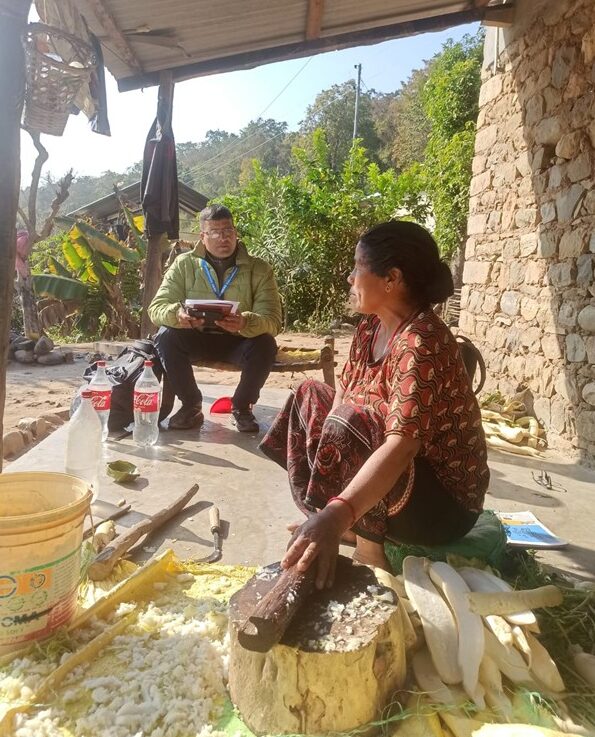
Climate change is not just heat and drought. It is also storms, heavy rains and deadly landslides. In this article, Prajwol Dhital, a REACT field researcher with the HERD International team in Nepal, relays the experiences of a female community health volunteer at one of our study sites. It is a story of loss, distress, economic hardship and a need for real change.
Jyana Pun has been living in Ward No. 2 of Ghorahi Sub-Metropolitan City. Her village, Chaklighat, lies in the hilly area near the banks of the Arjun River, surrounded by community forests. This village of around 100 households is largely inhabited by the historically marginalized Dalit and Janajati communities.
Although she earns her livelihood through agriculture, Jyana has also been serving her community as a Female Community Health Volunteer (FCHV) for the past 35 years. She expressed her understanding of climate change through strong winds, storms, and heavy rainfall causing floods and landslides. Her own personal experiences have been extremely painful and difficult. With sorrow, she recalled the impact of these natural disasters on her family:
“In 2013, a massive landslide destroyed our house and my brother-in-law’s house, our cowsheds, and killed 35 animals, including cows, oxen, buffaloes, goats, sheep, and pigs. Four years later, a landslide again swept away our house and cowshed. This time, it happened during the day when the animals had been taken to the forest for grazing, so they survived.”
She also added: “The second time, one of our neighbours got trapped under their collapsed house, but thankfully she survived.”
Having lost her home twice due to landslides, Jyana reflected on the anxiety she feels whenever the weather forecast suggests heavy rains, with thoughts and questions swirling through her mind and keeping her awake all night. She explained that this is not just her experience, but the reality that all families living in the area must face. Due to yearly threats of floods and landslides, she claimed that some of her neighbors have even stopped raising cattle and other livestock. Furthermore, there is also a severe shortage of drinking water during such disasters.
She mentioned that during the two disasters that destroyed her homes, the municipality provided tarpaulins and utensils, and in the latest incident they also provided corrugated metal sheets to build temporary shelters. However, she laments that no initiatives have been taken for a long-term solution: “We and our community are at great risk. We cannot carry our land away. We cannot even leave this place.”
Jyani’s words reveal the stark reality faced by marginalized communities in one of the most climate-vulnerable countries in the world. While the REACT Consortium will work to build the capacity and resilience of those within the health workforce, including FCHVs like Jyani, it is clear that this capacity and resilience needs to extend to multiple sectors and tiers of government, as well as the wider communities.