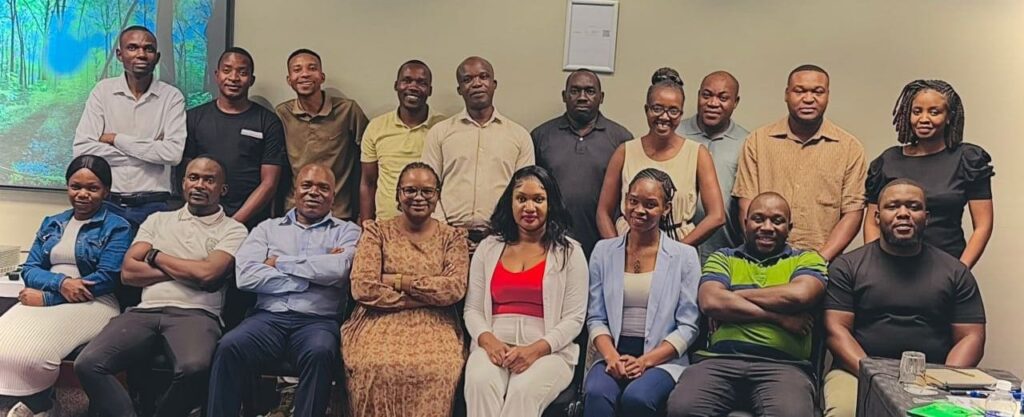
Calvin Kunaka, PhD student in the REACT Consortium at CeSHHAR Zimbabwe, reports on his team’s protocol and ethics training with the Medical Research Council of Zimbabwe.
Ethics training and protocol mastery are not box-ticking exercises; they are the backbone of research that communities can trust. It is the invisible architecture that holds every credible study together. Without them, even the most well-intentioned research risks causing harm, producing unreliable results, or failing the very people it sets out to serve. For the CeSHHAR team, that process took shape across two landmark training events held in February 2026, in preparation for the REACT study. First came a two-day ethics training session facilitated by the Medical Research Council of Zimbabwe (MRCZ) [opens new tab] on the 17th and 18th of February, followed swiftly by three-day protocol training from the 23rd to the 25th. Together, these trainings brought researchers, team leaders, and survey assistants face-to-face with the ethical principles and operational demands of one of CeSHHAR’s most important studies.
Ethics training
Research at the intersection of climate change and health workforce equity is inherently sensitive. The REACT study will engage health workers who are often overworked and under-resourced, operating in communities already bearing disproportionate burdens of climate-related disease, flooding, drought, and displacement. These are not abstract populations, they are people whose livelihoods, mental health, and futures are directly implicated in the study’s questions. This is precisely why the MRCZ-facilitated ethics training was not treated as a box-ticking exercise, but as a genuine intellectual and professional undertaking. Over two rigorous days, the CeSHHAR team deepened their understanding of core ethical principles governing human subjects research: respect for autonomy, informed consent, confidentiality, minimizing harm, and equitable benefit.
One of the most valuable outcomes of training sessions like these is the culture they help build. Ethics in research requires ongoing judgement, reflexivity, and team-wide accountability. The MRCZ training created a shared language and shared responsibility among the CeSHHAR team, ensuring that everyone understands their role in protecting study participants. Discussions during the training also touched on the unique ethical considerations that arise when researching vulnerable occupational groups in low- and middle-income settings. Health workers in Zimbabwe and across the region are navigating extraordinary pressures: climate-driven workload spikes, resource shortages, and personal risk. The team was guided on how to engage these participants with dignity, avoid extractive research dynamics, and ensure that the study’s findings feedback meaningfully into the communities that contributed to them.
Research integrity
Beyond protecting participants, ethical rigour strengthens the integrity of the REACT study itself. Research that is conducted with transparency, fairness, and respect produces data that communities, policymakers, and funders can trust. In a field as consequential as climate and health, trust is everything. The CeSHHAR team emerges from this training not simply with certificates, but with a reinforced commitment to conducting the REACT study in a manner that honours every participant, upholds scientific integrity, and ultimately contributes to a more just and climate-resilient health system in Zimbabwe and beyond.
Building operational readiness: The REACT protocol training
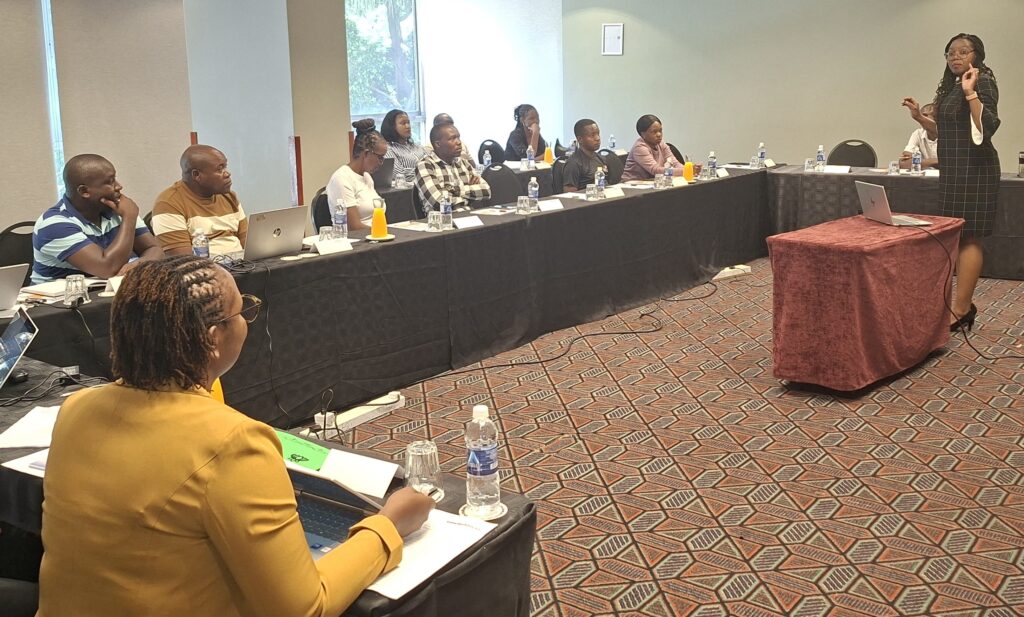
Hot on the heels of the ethics training, the CeSHHAR team reconvened from the 23rd to the 25th of February 2026 for a comprehensive three-day protocol training, marking another pivotal milestone in preparation for the REACT study. Where the ethics training had laid the moral and philosophical foundations of the study, this protocol training was focused on operational readiness: ensuring that every member of the field team was equipped with the knowledge, tools, and practical skills needed to carry out the study with consistency, rigour, and sensitivity.
The training was formally opened by Professor Euphemia Sibanda, the country Principal Investigator for the REACT study. Professor Sibanda’s opening remarks set a tone of purpose and professionalism for the three days ahead. She reminded the assembled survey assistants and research team members of the significance of the work they were about to undertake, not merely as data collectors, but as ambassadors of rigorous, ethical, and compassionate research. Her remarks underscored the REACT study’s dual mandate: to generate scientifically credible evidence about climate change’s impact on health workers, and to do so in a way that treats every participant as a partner rather than a subject. It was a fitting beginning to a training that would prove both intensive and inspiring.
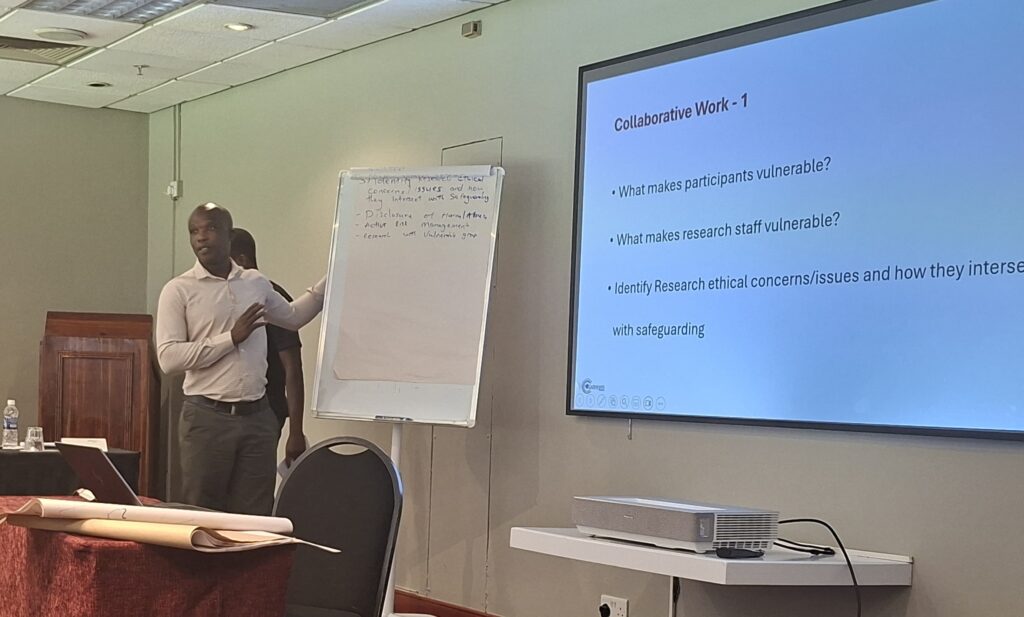
A central component of the protocol training was dedicated to safeguarding training. Given that the REACT study involves health workers operating in often high-pressure, low-resource environments, the team was trained to recognise and appropriately respond to safeguarding concerns that may arise in the field. Survey assistants were introduced to CeSHHAR’s safeguarding policies and the broader ethical duty of care that every field researcher carries. This included how to identify signs of distress or vulnerability in participants, how to make appropriate referrals, and how to maintain the boundaries necessary to protect both participants and staff. Safeguarding is not a peripheral consideration in health workforce research; it is central to the trust and dignity that must underpin every interaction in the field.
The training also included dedicated survey training sessions, during which survey assistants familiarised themselves with the REACT study’s data collection tools in depth.
Survey assistants were walked through each section of the survey tools, with facilitators explaining the rationale behind key questions and clarifying how responses should be captured accurately and consistently. Particular attention was paid to question wording, skip patterns, and the handling of sensitive questions related to health worker wellbeing, occupational stress, and climate-related exposures. Standardisation across the field team is essential in a multi-site study, and these sessions ensured that every survey assistant would administer the instruments in a uniform manner, reducing the risk of interviewer bias and enhancing the overall quality of the data collected.
Putting lessons into practice
Perhaps the most dynamic element of the three-day programme was the simulation role plays, which brought the training to life in a way that no textbook exercise could replicate. Survey assistants were paired up to practise conducting interviews in realistic scenarios, with some participants playing the role of health worker respondents while others administered the survey. These simulations were deliberately designed to reflect the kinds of challenges that are likely to arise in the field: reluctant participants, emotionally charged responses, logistical interruptions, and questions about the purpose of the study. Facilitators observed the role plays and provided structured feedback, helping each team member to refine their technique, build confidence, and develop the interpersonal skills needed to put participants at ease and maintain the integrity of the data collection process.
Together, the ethics and protocol trainings represent a comprehensive investment in the quality and integrity of the REACT study. The CeSHHAR team enters the fieldwork phase not only with the necessary technical knowledge but with a shared commitment to the values that make research transformative rather than merely transactional. As Zimbabwe navigates the compounding pressures of climate change and a strained health system, the rigour and care invested in studies like REACT become ever more important. The findings that emerge from this work have the potential to inform policies that genuinely improve the lives and working conditions of health workers but only if the research itself is conducted with the highest standards of excellence. These trainings are proof that the CeSHHAR team is ready to meet that challenge.